The "unsafe" ransomware group is a relatively new threat actor that emerged in December 2022, operating with primarily financial motivations through ransomware deployment and extortion schemes. Based on limited public documentation, the group's origin and specific affiliations remain unclear, though their operational patterns suggest they function as an independent ransomware operation rather than a established Ransomware-as-a-Service model. With 14 documented victims since their emergence, the group has demonstrated a focused targeting approach, primarily concentrating their attacks on manufacturing organizations, transportation and logistics companies, and government entities across the United States, Switzerland, and France. Their attack methodology and specific technical capabilities have not been extensively documented by major security research organizations such as CISA, FBI, or Mandiant, limiting detailed analysis of their initial access vectors, encryption methods, or data exfiltration practices. No major high-profile campaigns or significant law enforcement actions have been publicly reported against this group, likely due to their relatively recent emergence and smaller scale of operations compared to more established ransomware families. Current intelligence suggests the group remains active as of available reporting, though their limited public footprint makes definitive status assessment challenging without additional threat intelligence sources. The group has been linked to 23 public disclosures across our corpus. First observed on a leak site on December 21, 2022; most recent post September 12, 2026. The operation is currently inactive.
Sector and geography
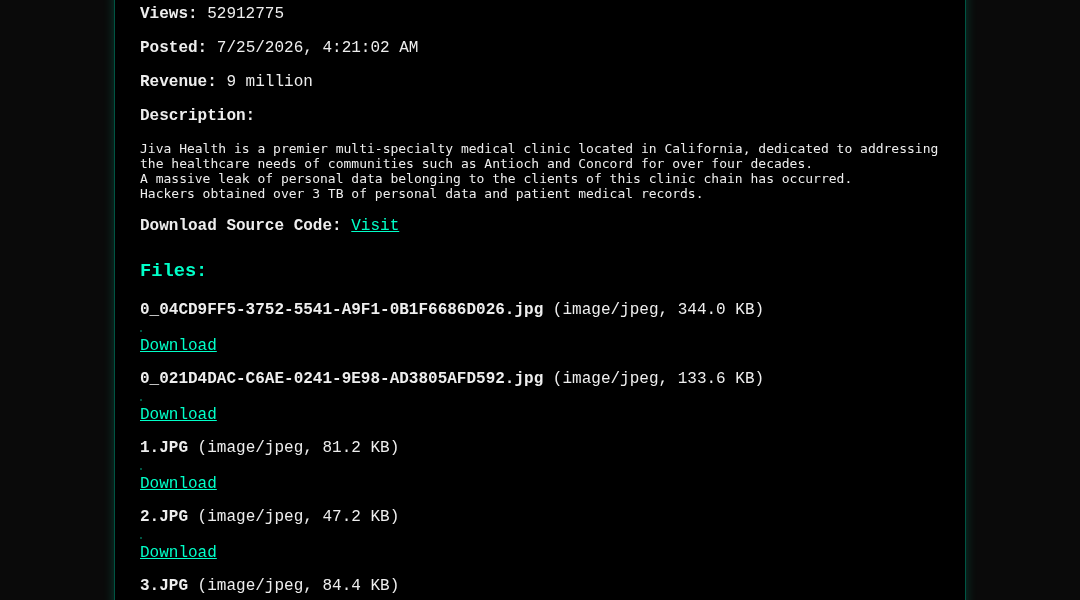
This disclosure adds to ransomware activity in the Healthcare sector, which has 2,608 disclosures indexed across all operators we track. Geographically, Jiva Health is reported in India, a country with 243 ransomware disclosures in our corpus.
If your organisation is affected
A listing by unsafe means Jiva Health appeared on a ransomware extortion site and data attributed to it has been published. If this is your organisation, or a supplier you depend on, the priority is to confirm the intrusion and contain it before the window to act closes.
- Engage your incident-response team and preserve forensic evidence before remediating — do not wipe affected systems first.
- Force a password reset and revoke active sessions for exposed accounts; rotate any credentials, API keys or certificates that may have been in the stolen data.
- Assess regulatory notification duties (GDPR, NIS2, sector regulators) — many carry a 72-hour reporting clock from awareness.
- Report the incident to your national CERT, CERT-In (India), as required for your jurisdiction.
- Monitor for the data appearing on unsafe's leak site and across paste and breach channels, and brief downstream partners who may be exposed through you.
How we know this. Darkfield monitors public ransomware leak sites continuously, archiving every new disclosure and the data later released against the victim. Each entry on this page is sourced from the operator's own publication and cross-checked against complementary OSINT feeds (RansomLook, ransomware.live, RansomWatch). We do not collect or host stolen data — only the metadata, timestamps and screenshots needed to make the public disclosure searchable and accountable. Records here are corrected when the original post is edited, retracted, or merged with another disclosure.